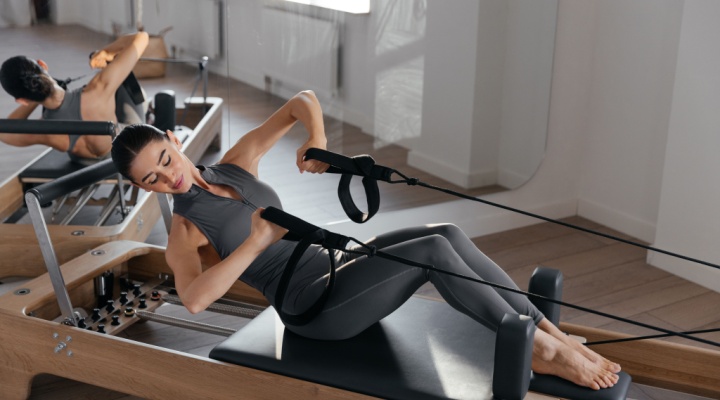
Clinical Pilates vs. Gym-Based Pilates vs. Studio Pilates: What’s Actually Different and Who Needs What
If you live in inner Sydney, you’ve watched reformer Pilates studios multiply at a pace that suggests the city has been hiding a vast unmet need for spring resistance and activewear. The boom is real — and so is the confusion it has created about what Pilates actually is, why it costs what it does and which version you actually need.
The answer matters more than most people realise, because for a meaningful proportion of people currently attending group reformer classes, what they actually need is something clinically quite different.
Studio and Gym-Based Pilates: What You’re Getting
Group reformer classes at commercial studios are a legitimate form of exercise. They build strength, improve mobility, develop body awareness and offer a structured workout in a social environment. For generally healthy people who want to move well and feel better, they deliver real value.
Gym-based mat Pilates sits at the more accessible end — lower cost, less equipment, more variable in quality depending on the instructor’s training. For baseline fitness and flexibility work, it’s perfectly reasonable.
What both formats share: the instructor is not a physiotherapist, the class is not designed around your specific body and the program does not adapt in real time to your injury history, your movement dysfunction or your rehabilitation goals. In a group of twelve, the instructor cannot assess whether your lower back is compensating for weak hip flexors, or whether the exercise they’ve just cued is loading a structure that’s currently irritated.
For most healthy participants, this is fine. For people with an injury, post-surgical recovery, chronic pain or a specific movement problem, it can be actively counterproductive — and occasionally harmful.
Clinical Pilates: The Fundamental Difference
Clinical Pilates at Body Active in Alexandria and Mascot is Pilates supervised one-on-one by a physiotherapist. That distinction is not a marketing distinction — it is a clinical one.
Before your first session, your physio conducts a proper assessment: your injury history, your movement patterns, your muscle recruitment, your postural compensations and what you’re actually trying to achieve. The exercises prescribed are built around that specific picture, not a generic program. As your capacity changes — as strength builds, as pain settles, as movement improves — the program adapts. Your physio can see what your body is doing in real time and correct it immediately.
This matters enormously for conditions including lower back pain, hip dysfunction, post-surgical rehabilitation, pelvic floor issues, shoulder instability and any situation where the wrong loading pattern would set recovery back. Health fund rebates apply, which meaningfully reduces the out-of-pocket cost compared to what people often assume.
The Body Active Advantage: Where Clinical Meets Gym
Body Active’s Alexandria clinic is co-located with Plus Fitness — a genuinely unusual arrangement that creates a seamless pathway from clinical rehabilitation back to general fitness. A patient who enters for post-surgical clinical Pilates and progresses to a point where they can handle a gym environment doesn’t need to change providers or lose the continuity of care. The transition is managed by the same team, in the same building.
For the inner-west population of active adults who want to return to strength training, CrossFit, running or sport after injury, this matters practically. You’re not discharged into the unknown — you’re walked across the corridor.
The Honest Summary
Studio reformer Pilates is great for: general fitness, healthy bodies, movement quality and social exercise.
Clinical Pilates is appropriate for: recovering from injury, managing chronic pain, post-surgical rehabilitation and any situation where a physiotherapist’s assessment and ongoing supervision would change what exercises are appropriate.
If you’re currently attending group reformer classes while managing a sore back, recovering from a procedure or working around a niggling injury — it’s worth having a conversation about whether clinical Pilates is what you actually need.